

- Banks often catch scams after the money is gone.
- A new platform uses shared anonymised signals to stop scams sooner.
Banks and companies in finance, payments, telecomms, e-commerce, and gaming face a steady rise in digital fraud. Many of these scams cut into institutions, yet most firms still work in isolation. Group-IB’s new Cyber Fraud Intelligence Platform (CFIP) aims to close the gap by giving organisations a way to spot shared threats in real time without exposing personal data.
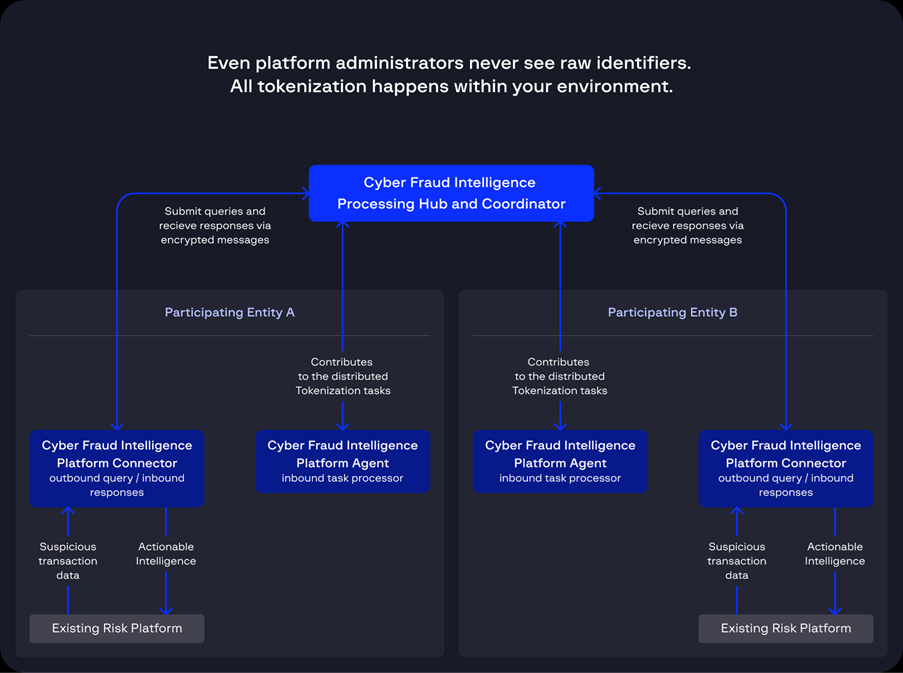
CFIP works with existing fraud and risk tools and does not depend on any single system. It uses Group-IB’s distributed tokenisation method, which Bureau Veritas has independently confirmed as fully GDPR-compliant. The approach lets firms exchange anonymised “risk signals” that reveal fraud patterns that are hard to detect alone.
By matching signals as they happen, CFIP may help stop scams like authorised push payment (APP) fraud, investment schemes, romance scams, business email compromise (BEC), mule networks, synthetic identities, and account takeovers. The goal is to block transfers before the money disappears.
Real-time checks without exposing data
A major issue in fraud prevention is timing. Traditional sharing usually happens only after a case is confirmed, which is often too late. CFIP is built around distributed tokenisation, allowing organisations to compare suspicious activity before a payment goes through. This makes it easier to catch APP fraud, mule activity, or unusual behaviour tied to an account while the user still has control.
All shared data stays anonymous, and personal information never leaves the institution. Bureau Veritas has verified the platform’s architecture and data-handling process, making CFIP the first fraud intelligence platform to receive this level of privacy validation.
“CFIP bridges one of the biggest gaps in financial-crime prevention – the ability to collaborate securely,” said Julien Laurent, financial crime and compliance specialist at Group-IB. “By combining real-time risk-signal sharing with independently verified privacy safeguards, CFIP allows the industry to work together to stop fraud before it happens.”
“Financial crime is one of the most complex and costly challenges of our time, and no single organisation can solve it alone. CFIP reflects our commitment to tackling digital crime through collaboration – proving that when privacy, compliance, and shared intelligence come together, the entire financial ecosystem becomes stronger and more resilient,” said Dmitry Volkov, CEO of Group-IB.
Moving from isolated clues to shared prevention at scale
Modern scams often move too fast for traditional systems. Victims of APP fraud can be persuaded to send funds themselves, and criminals can shift money in banks in minutes. Once the transfer is made, recovery is rare.
CFIP runs on AWS as part of the AWS ISV Accelerate programme and connects to case-management and risk systems. Its microservice design supports high transaction volumes and cross-border setups, with proven performance of more than 25 million transactions per day in national rollouts.
For firms that must keep data on-site, the platform also supports on-premise and hybrid setups to meet local rules.
Supporting global regulatory demands
Regulators around the world urge firms to share fraud intelligence more widely, but many rules stop short of explaining how to do it safely and at scale.
CFIP offers a structure that fits these requirements, including the UK Payment Systems Regulator’s Specific Direction 20, the EU’s AMLR (Article 75), Singapore’s COSMIC framework, and Australia’s Scam-Safe Accord. It also aligns with FATF guidance on private-to-private data sharing and ongoing efforts by the US Department of Treasury to improve AML/CFT systems.
Practical results in early deployments
In a national rollout in Central Asia, CFIP already flags 300-400 mule accounts each day and performs around 180,000 checks. At full scale, projected savings range from $100-300 million per year.
CFIP helps close gaps that criminals exploit by moving in different banks. Key use cases include:
- APP fraud prevention: Real-time checks on recipient accounts before money leaves the sender’s bank.
- Account takeover detection: Device and session clues reveal when one actor is controlling multiple compromised accounts.
- Early mule detection: Low-value “warm-up” transactions become visible in institutions.
- Synthetic identity and KYC fraud: Shared signals link fake identities through reused phone numbers, addresses, or documents.
- Loan application fraud: Coordinated attempts in lenders can be flagged.
- Track and trace: Banks can trace funds across institutions to improve recovery efforts.
A push for broader cooperation
CFIP is built to support the type of collaboration that regulators and industry groups encourage. It gives banks, regulators, and industry bodies a way to work together without losing control of private data. Group-IB’s fraud protection work has already received industry attention, including the “Anti-Fraud Project of the Year” award from Regulation Asia in 2023.

Want to experience the full spectrum of enterprise technology innovation? Join TechEx in Amsterdam, California, and London. Covering AI, Big Data, Cyber Security, IoT, Digital Transformation, Intelligent Automation, Edge Computing, and Data Centres, TechEx brings together global leaders to share real-world use cases and in-depth insights. Click here for more information.
TechHQ is powered by TechForge Media. Explore other upcoming enterprise technology events and webinars here.